Welcome to The Deductivist
Every person is an open book — if you know how to read them
Learn to Read People
Like Sherlock Holmes
Every week, one concrete observation and deduction technique you can practise the same evening.

Join the first readers of The Deductivist
Instant delivery. No spam. Unsubscribe with one click.
Paid membership is intentionally small.
Quality over scale.
Your first case
Holmes never started with the face. He started with the shoes,
the gloves, the handkerchief.
Because that is where people
forget to lie. This PDF guide shows you exactly what he saw.

When I meet a stranger, within thirty seconds I know more
about their life than they themselves have learned in thirty years.
Sherlock Holmes
A Study in Scarlet
what's inside the PDF
Shoes as biography
Sole wear, lace condition, shoe type — what every detail reveals about profession, habits and character.
Hands and wrists
Calluses, skin, watch — Holmes read occupation, health and marital status from hands alone.
Micro-expressions
7 emotions the body reveals before the mind has time to lie — and how to catch them.
Proxemics and territory
How far someone stands from you and what it says about their intentions — behavioural psychology in practice.
Tonight's exercise
One exercise to try today — in a café, on the subway, anywhere.

How it works
Every week, one case. One technique. Immediately applicable.
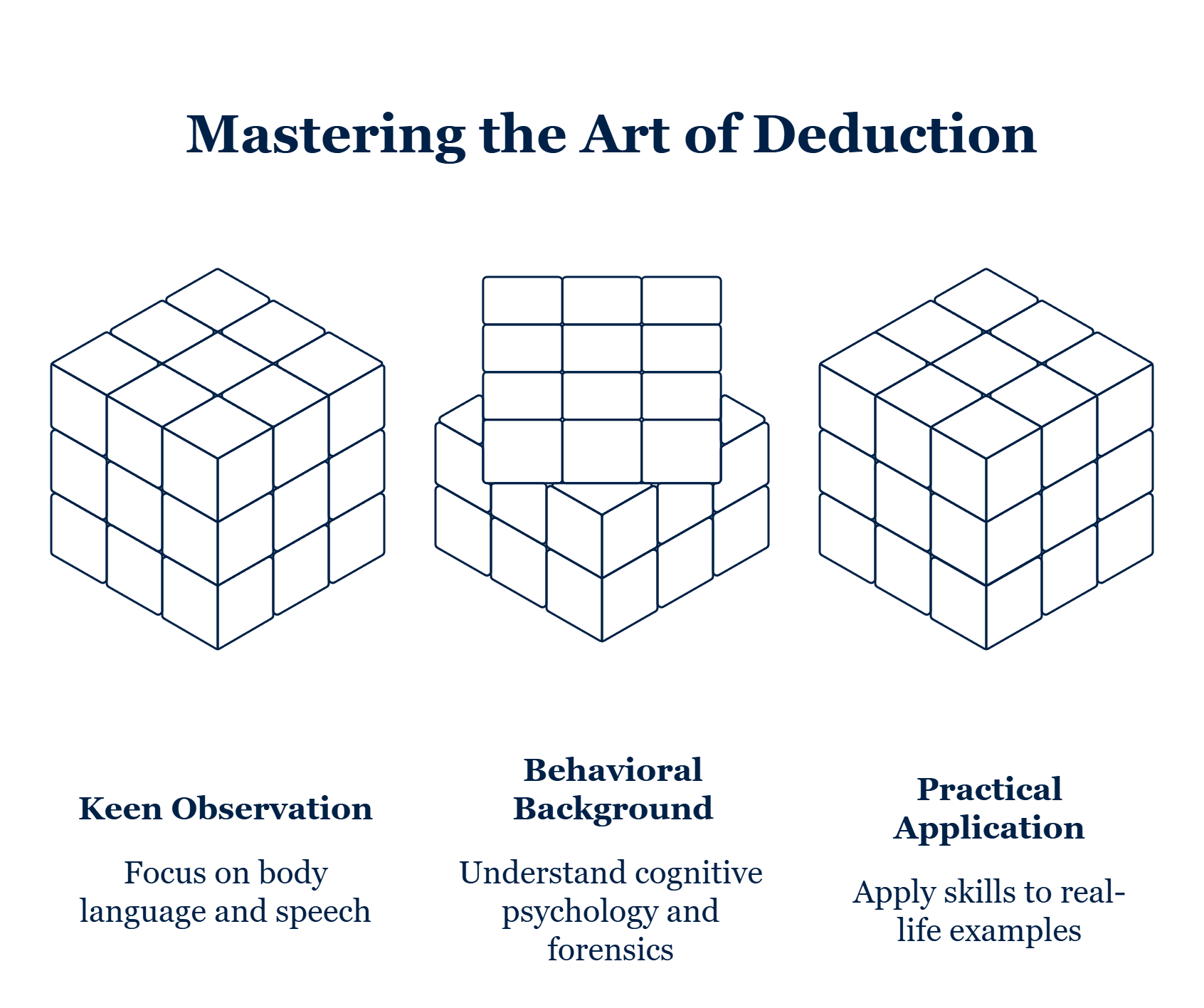
01
Observation
You learn to see precisely what others overlook. Not guessing — deducing from concrete facts.
02
Behavioural background
Every technique is grounded in science — cognitive psychology, neurolinguistics or forensics.
03
A story from practice
No theory without an example. Every issue includes a real case — from life or from Holmes's casebook.
04
Your case this week
A concrete exercise to try the same day. Deduction is not learned by reading — but by doing.
What readers say
"I started perceiving every conversation differently."
"I have been interested in behavioural psychology for years but always struggled to apply it in real situations. The first issue alone changed how I observe people. I noticed things I had walked past every day for years!"

John Maxwell
Student, Charles University
"I expected interesting content. I did not expect to immediately start using it. The exercise in issue one took fifteen minutes and I have not looked at a pair of shoes the same way since."

Alexandra Oravska
Civil servant, The Government of the Czech Republic
"The customer support team goes above and beyond to help. Their dedication and quick responses have truly impressed me."
David Siegel
First-time subscriber
"In my field, reading people accurately matters more than most professionals admit. The methodology here is rigorous enough to take seriously and practical enough to actually use."
Clifford Peterson
Laboratory director

Join Holmes's Circle of Detectives
Free when you sign up
PDF guide + 5 introductory emails, free. Then decide whether you want to continue.

The Deductivist
$5,90
/month · cancel anytime

A new deduction technique every week
Behavioural breakdown + scientific background
Story from practice + exercise
Access to the full archive
Subscribers first to receive new methods

Be among the first readers.
THE COMMON MISTAKE
Most People Don't Deduce.
They Assume.
There is a difference between observation and assumption. Most people skip the first step entirely and call the result intuition. Holmes called it guessing. He was not complimentary about it.

MISTAKE #1
MISTAKE #2
MISTAKE #3
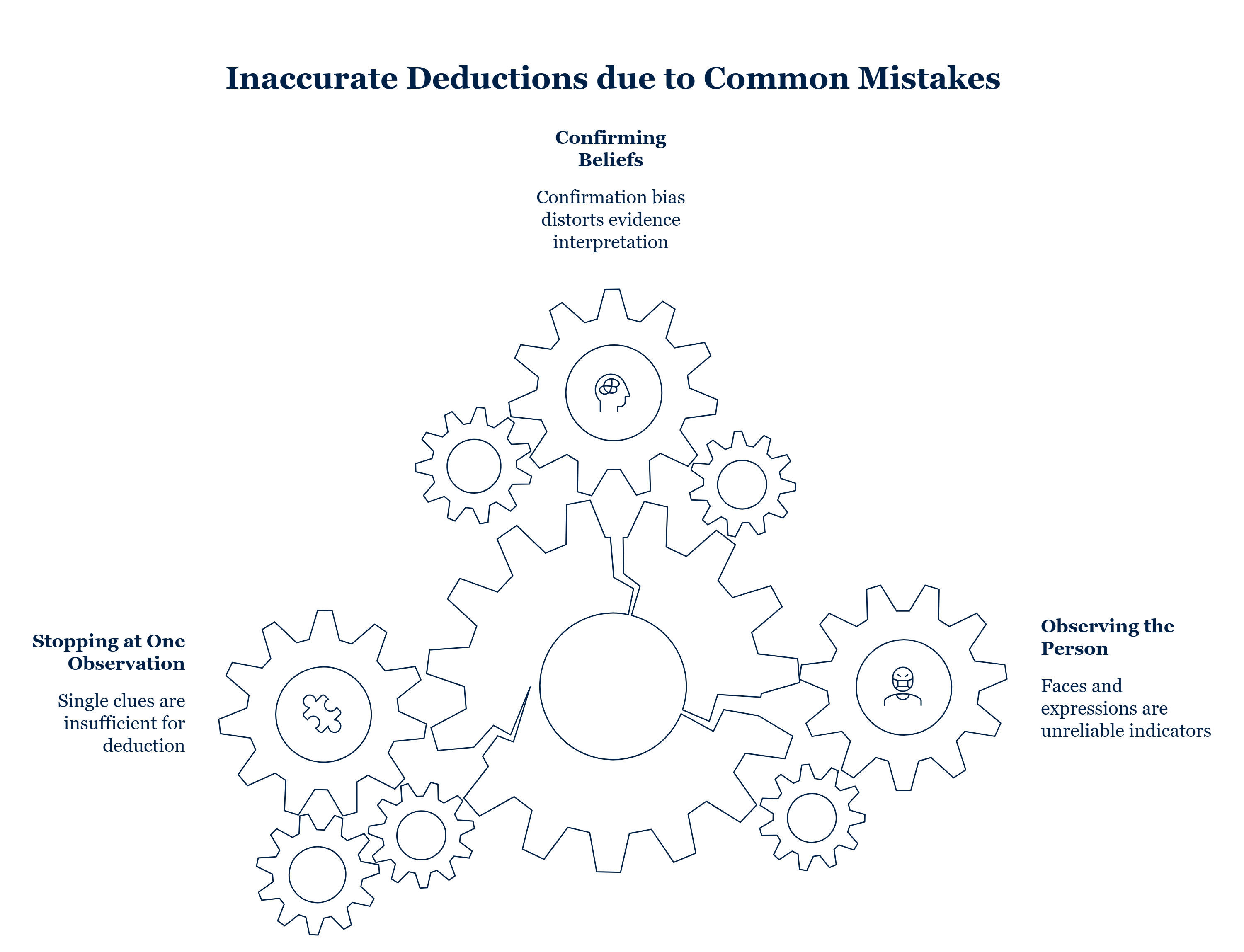
Observing the person, not the evidence
Confirming what we
already believe
Stopping at one observation
We look at faces. Faces perform. We read expressions. Expressions lie. We notice clothes. Clothes are chosen deliberately.
Holmes looked at what people forgot to manage: shoes, hands, posture under stress. The unguarded details.
The mind finds what it looks for. If you decide someone is nervous, you will find nervousness everywhere. This is confirmation bias — and it destroys accuracy.
True deduction follows evidence. It does not lead it.
A single clue proves nothing. Holmes never concluded from one detail. He accumulated evidence until the hypothesis became inevitable.
One worn heel is interesting. Three converging observations is a deduction.
THE METHODOLOGY
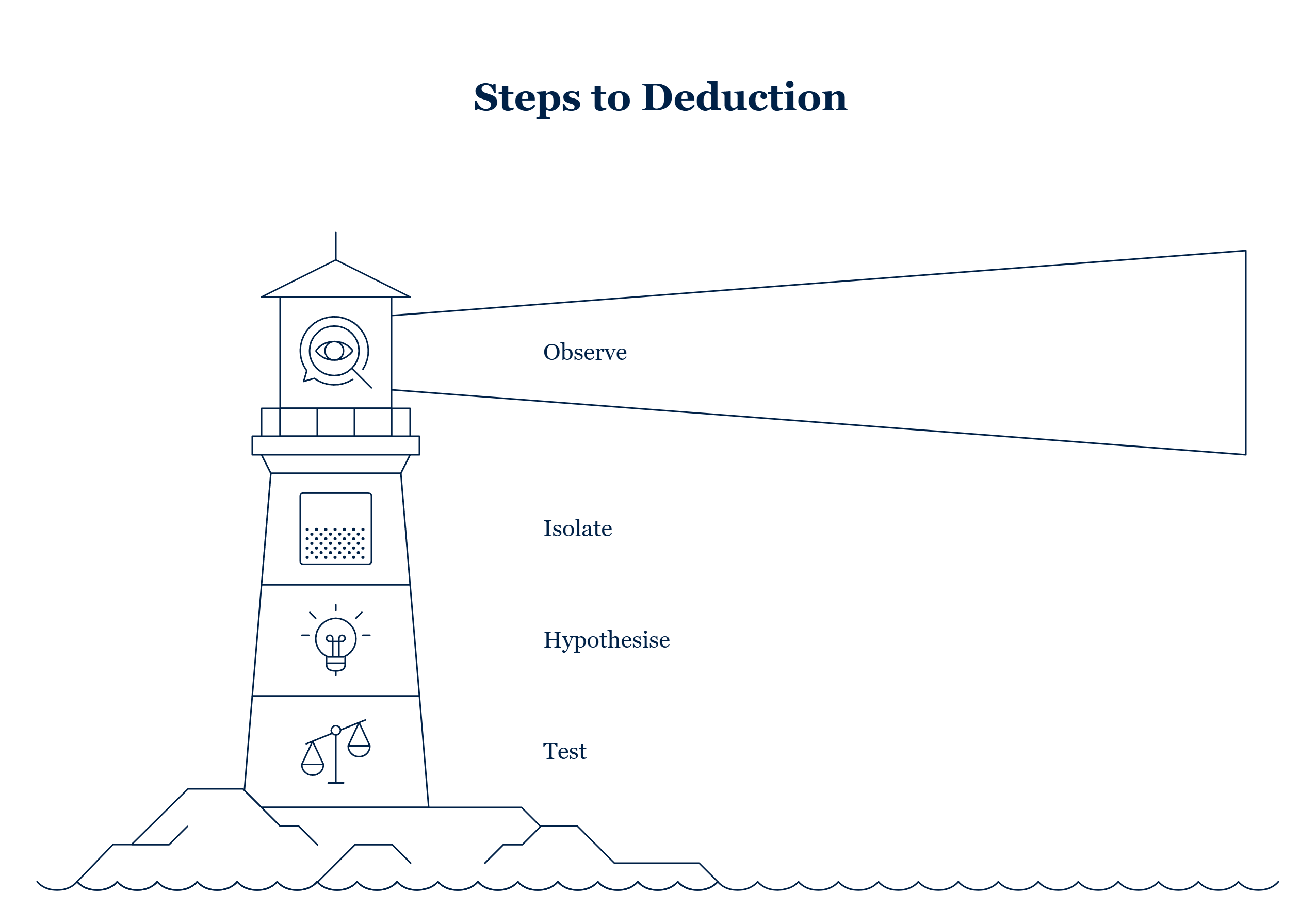
The Four-Step Deduction Method
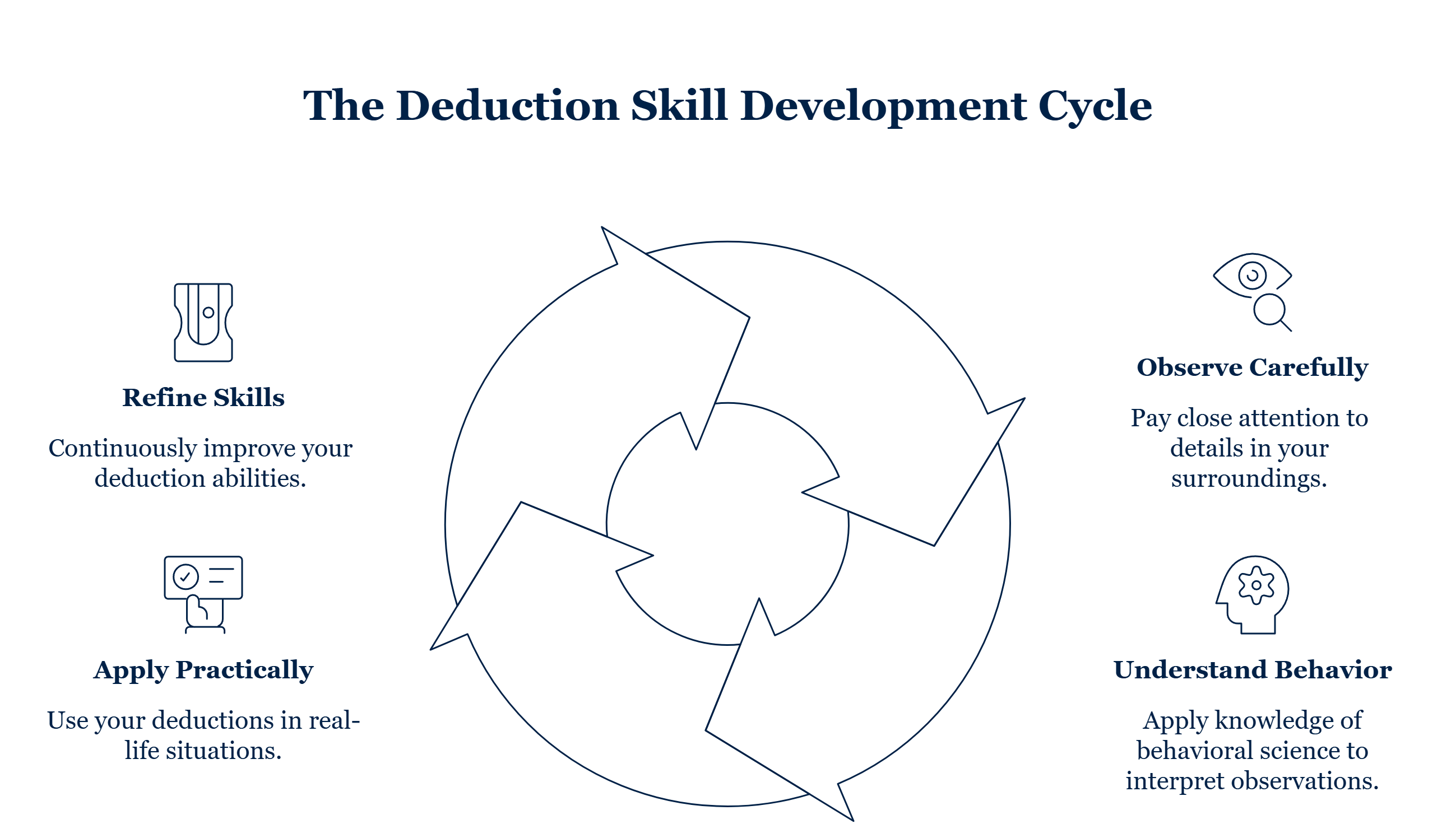
Holmes's method was not mysterious. It was systematic. The same four steps, applied consistently, to every person he encountered. This is what The Deductivist teaches — one step at a time.
01 — OBSERVE
02 — ISOLATE
03 —HYPOTHESISE
04 — TEST
Look before you interpret. Collect raw data: physical details, behaviour, environment. No conclusions yet. Just facts.
"It is a capital mistake to theorise before one has data."
Separate the significant from the incidental. Not every detail matters. A worn sole matters. A blue tie does not — unless it does.
Form one specific, falsifiable statement: "This person is likely..." Ground it entirely in observed evidence. Nothing else.
Find a second piece of evidence. Does it confirm or contradict? Revise accordingly. Repeat. This is deduction. This is not intuition.
It is a capital mistake to theorise before one has data.
Insensibly one begins to twist facts to suit theories,
instead of theories to suit facts.
Sherlock Holmes
A Scandal in Bohemia
The Deductivist teaches this method one technique
at a time — every week, in under ten minutes. Start with the free guide. No commitment required.
"Elementary, my dear reader."



© 2026 The Deductivist. All rights reserved.