THE DEDUCTIVIST
ABOUT
This newsletter exists because most people look without seeing.
The story behind The Deductivist
17:00. Prague metro. The hour when the system moves people with quiet efficiency and minimal reflection, like paperwork being processed in bulk.
The train arrives. Doors open. A brief, silent agreement is reached between those exiting and those attempting to enter prematurely (it fails, predictably, but the attempt is noted).
Inside, the usual composition: phones held at a consistent downward angle, eyes fixed, bodies present but administratively disengaged. A carriage full of individuals who have outsourced perception to habit.
Nothing unusual, which is precisely the point.
A man stands near the door, shifting his weight from one foot to the other in a rhythm that suggests impatience rather than necessity. No one looks at him. They register “person,” file it under “irrelevant,” and proceed.
Across from him, a woman rereads the same message for the fourth time. Not out of confusion. Out of calculation. Her expression changes by fractions, each one containing more information than the text itself. No one notices. The message is considered the event. It is not.
The train stops. A delay longer than standard. No announcement.
A few passengers glance up, briefly, as if checking whether reality still intends to cooperate. It does not clarify. They return to their screens. The system has not issued instructions, so observation is suspended.
That was the moment.
Not dramatic. Not cinematic. Just structurally precise.
An entire carriage, fully equipped with eyes, choosing not to see unless prompted. Waiting for information that was already available, provided they were willing to process it without permission.
(It is easier to be told than to notice. There is less responsibility in it.)
The realization was not that people are unaware.
It was that they are selectively blind in ways that are both predictable and, once understood, useful.
The metro resumed movement. No one acknowledged the interruption. The event was closed without being examined.
By the time the train reached the next station, everything had returned to normal.
It had not.
The system continued. The passengers complied.
The observation remained.
Holmes was not supernatural. He was not gifted
with powers unavailable to the rest of us.
He simply paid attention to things other people
had decided were not worth noticing.
This newsletter is about learning to do the same.

THE METHOD
Sherlock Holmes used a systematic approach to
observation that has since been validated, piece
by piece, by cognitive psychology, behavioural
science, and forensic research.
He started with physical evidence — shoes, hands,
posture, proxemics — and worked upward. He formed
hypotheses only after collecting data. He revised
them when the evidence demanded it.
This is not intuition. It is a learnable skill.
Each issue of The Deductivist teaches one part
of that skill — grounded in science, applied
to everyday life, and practised the same day
you read it.

WHAT THE DEDUCTIVIST IS
A weekly newsletter. One issue, every week.
Each issue follows the same structure:
— One concrete observation technique
— The behavioural science behind it
— A real case study with analysis
— One exercise to try the same day
Reading time: five to ten minutes.
Application time: the rest of the day.
WHAT IT IS NOT
This is not a newsletter about Sherlock Holmes
the fictional character, though he appears
regularly and is rarely wrong.
It is not a course, a membership community,
or a self-help programme. It is a newsletter.
One technique. Once a week. Applied immediately.
The accumulation of these techniques, over time,
produces something that looks like intuition
but is not. It is observation. Trained,
systematic, and entirely learnable.
"You have been in Afghanistan, I perceive."
Holmes did not say: "I have a feeling you've
been somewhere warm recently."
He observed. He deduced. He stated.
That is the difference this newsletter teaches.
Meet the Minds Who Somehow Figured This Out
These brilliant, occasionally sane humans are the reason The Deductivist exists.

Matthew Blackwood
Chief Deductor
Spends most of the day staring at things that probably don’t exist, and somehow turns it into insights you can actually use.



Samuel Nekula
Puzzle Whisperer
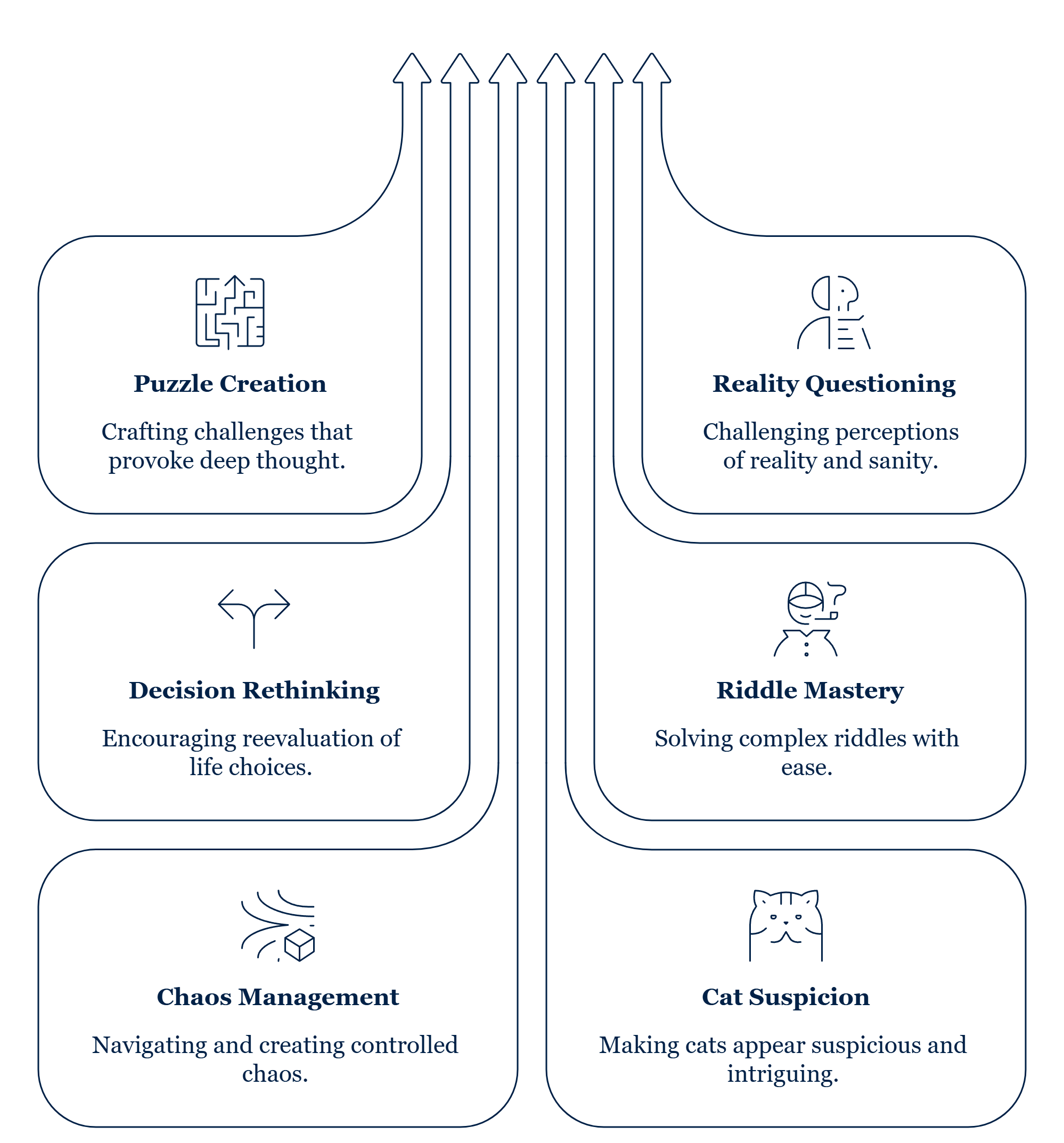
Creates riddles and challenges that make you question reality, your life choices, and why you ever thought cats were trustworthy.